# Water quality

## Units

<table border="1" id="bkmrk-l-gallons-%28us%29-1-0.2" style="border-collapse: collapse; width: 100%; height: 235.466px;"><colgroup><col style="width: 50.0377%;"></col><col style="width: 50.0377%;"></col></colgroup><thead><tr style="height: 29.4333px;"><td style="height: 29.4333px;">**L**</td><td style="height: 29.4333px;">**Gallons (US)**</td></tr></thead><tbody><tr style="height: 29.4333px;"><td style="height: 29.4333px;">1</td><td style="height: 29.4333px;">0.264</td></tr><tr style="height: 29.4333px;"><td style="height: 29.4333px;">3.785</td><td style="height: 29.4333px;">1</td></tr><tr style="height: 29.4333px;"><td style="height: 29.4333px;">6</td><td style="height: 29.4333px;">~1.5</td></tr><tr style="height: 29.4333px;"><td style="height: 29.4333px;">12</td><td style="height: 29.4333px;">~3</td></tr><tr style="height: 29.4333px;"><td style="height: 29.4333px;">20</td><td style="height: 29.4333px;">~5</td></tr><tr style="height: 29.4333px;"><td style="height: 29.4333px;">30</td><td style="height: 29.4333px;">~8</td></tr><tr style="height: 29.4333px;"><td style="height: 29.4333px;">40</td><td style="height: 29.4333px;">~10</td></tr></tbody></table>

## Total Ammonia Nitrogen (NH<sub>3</sub>/NH<sub>4</sub><sup>+</sup>) to PPM

[![1000016814.png](https://wiki.hexadust.net/uploads/images/gallery/2026-01/scaled-1680-/lvY7BfF79phXd5eI-1000016814.png)](https://wiki.hexadust.net/uploads/images/gallery/2026-01/lvY7BfF79phXd5eI-1000016814.png)

Drop test result \* 0.0131 @ 24C, 7.4PH = unionized ammonia.

Dangerous level for fish is 0.05.

## **Nitrogen Cycle**

- [Source](https://aquifarm.com/nitrite-in-aquarium/)

1. **Ammonia (NH₃):** Fish produce waste, and uneaten food decays. Both of these create toxic ammonia.
2. **Nitrite (NO₂):** A first type of beneficial bacteria consumes this ammonia and converts it into nitrite. This is where your problem starts. While it’s a necessary step, nitrite is *extremely* toxic to fish.
3. **Nitrate (NO₃):** A second type of beneficial bacteria then consumes the nitrite and converts it into nitrate. Nitrate is far less harmful and is managed with regular water changes and live plants.

<p class="callout warning">**Ammonia (NH₃)** and **Nitrite (NO₂)** are toxic to fish!</p>

<p class="callout warning">Nitrite poisoning is often called “Brown Blood Disease.” It gets this name because nitrite enters a fish’s bloodstream and interferes with hemoglobin, the part of the blood that carries oxygen. It essentially turns their blood a brownish color and prevents it from transporting oxygen effectively.  
Even if there’s plenty of oxygen in the water, a fish suffering from nitrite poisoning is slowly suffocating from the inside. This is why you might see them gasping at the surface, breathing rapidly, or acting very weak. **Any level of nitrite above 0 ppm (parts per million) is stressful and potentially lethal.**</p>

### Reducing Nitrite (NO₂)

- Perform a 50% water change
- Add a detoxifier
- Increase aeration
- Stop feeding fish for 24-48 hours

Sustain low level:

- Regularly replace water
- Add aquarium salt with water changes - promote gill function
- Good filtration system - clear out all waste and pollutants from the tank; raising oxygen levels in the tank and providing living space for nitrifying bacteria to thrive.
- Add nitrification bacteria

### The Typical Cycling Pattern

- Source: [https://www.shrimpkeepers.com/parameters/nitrite/](https://www.shrimpkeepers.com/parameters/nitrite/)

1. **Week 1-2**: Ammonia (NH₃) rises, no nitrite (NO₂)
2. **Week 2-4**: Ammonia-eating bacteria establish, ammonia drops, nitrite (NO₂) SPIKES
3. **Week 4-6**: Nitrite-eating bacteria establish, nitrite (NO₂) drops, nitrate (NO₃) rises
4. **Week 6+**: Cycle complete - both ammonia (NH₃) and nitrite (NO₂) at 0

<p class="callout success">Adding ammonia and bacteria to aquarium without fish can speed up the process.</p>

## General hardness

- [https://waternitylab.com/water-hardness-dh-to-ppm/](https://waternitylab.com/water-hardness-dh-to-ppm/)

[![hard-water-dh-degrees-to-ppm.webp](https://wiki.hexadust.net/uploads/images/gallery/2026-03/scaled-1680-/QCsd8m0UMdHGkP2L-hard-water-dh-degrees-to-ppm.webp)](https://wiki.hexadust.net/uploads/images/gallery/2026-03/QCsd8m0UMdHGkP2L-hard-water-dh-degrees-to-ppm.webp)
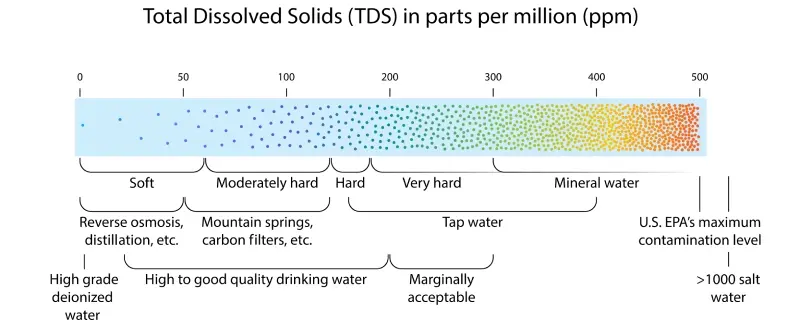
- **dH** or ***d**egree of **H**ardness* (also referred to as the ***d**egree of **G**eneral **H**ardness* (**dGH**) or German degree) is a unit of water hardness equal to **10 mg/L of calcium oxide** (CaO).
- **PPM** or ***P**art **P**er **M**illion* is a unit of water hardness equal to **1 mg/L of calcium carbonate** (CaCO<sub>3</sub>).

**PPM = dGH × 17.848**

<table border="1" id="bkmrk-dh-ppm-1.0-18-3.0-54" style="border-collapse: collapse; width: 100%; height: 117.4px;"><colgroup><col style="width: 50.0328%;"></col><col style="width: 50.0328%;"></col></colgroup><thead><tr style="height: 29.35px;"><td style="height: 29.35px;">**dH**</td><td style="height: 29.35px;">**PPM**</td></tr></thead><tbody><tr style="height: 29.35px;"><td style="height: 29.35px;">1.0</td><td style="height: 29.35px;">18</td></tr><tr style="height: 29.35px;"><td style="height: 29.35px;">3.0</td><td style="height: 29.35px;">54</td></tr><tr style="height: 29.35px;"><td style="height: 29.35px;">5.0</td><td style="height: 29.35px;">90</td></tr><tr><td>7.0</td><td>125</td></tr><tr><td style="width: 25%; height: 24px;">9.0</td><td style="width: 25%; height: 24px;">160</td></tr></tbody></table>