
Using CP/M
CP/M Quick Reference
Control key commands
CTRL + C |
Restarts CP/M by initiating a warm start |
CTRL + E |
Forces the cursor to the next line of the screen for continued command line input. |
CTRL + H |
Moves the cursor one space to the left in the same manner as the BS key. |
CTRL + I |
Inputs a tab code (same as the TAB key) |
CTRL + P |
Turns on or off the printer echo function. When the printer echo function is turned on, data displayed on the LCD screen is output to the printer (or other device assigned to LST:) each time the RETURN key is pressed. The printer echo function is turned on by pressing CTRL + P once and is turned off when CTRL + P is pressed a second time. (Make sure the printer is connected properly before using this command.) |
CTRL + R |
Redisplays the contents of the current command line. |
CTRL + S |
Momentarily stops processing currently being performed (same as the PAUSE key). Processing can be resumed by inputting this command again. |
CTRL + U |
Cancels the current command line and moves the cursor to the next line on the screen for input of a different command. |
CTRL + X |
Erases the current command line and moves the cursor back to the beginning of the line. |
CTRL + Z |
Terminates input from the keyboard (used in combination with certain CP/M transient commands). |
Commands
d: - A drive letterfilematch - an exact filename, or a wildcard match for files.
Items such as [item] are optional, ones such as <item> are compulsory.
DIR [d:][filematch]
Display a list of files in the specified, or current drive.
ERA [d:]<filematch>
Erase specified files. filematch *.* can be used to match all files in the current drive.
REN [d:]newname.ext = oldname.ext
Change the name of a disk file from oldname.ext to newname.ext
SAVE n [d:]filename.ext
Save the specified n number of pages of the transient program area to disk under the specified file name.
TYPE [d:]filename.ext
Display the contents of the specified file on the display screen. Display is only meaningful if the file contents was ASCII text.
USER n
Switches to the specified user area in a disk drive.
A user area is a physical area on a disk which has its own directory and which is managed separately from the rest of the disk. Data cannot be read from or written to any user area other than that in which CP/M is currently operating. A disk can be divided up into a maximum of 16 user areas.
PIP
Copy FOO.TXT to console (print).
C:PIP CON:=A:FOO.TXTWrite to file from terminal (CTRL-Z to EOF, CTRL-M+J for new line):
C:PIP FOO.TXT=CON:Copy file from current drive to A:
C:PIP A:UPLOAD.COM=UPLOAD.COMED
- http://www.gaby.de/cpm/manuals/archive/cpm22htm/ch2.htm
Commands mode
#a |
load all lines from file (given as arg to the command) to memory |
10a |
load 10 lines from file |
b#t |
go to beginning, print all lines |
b |
go to beginning |
n or -n |
move n lines ahead/behind and print |
t |
print current line |
k |
kill current line |
i |
insert before current line |
e |
save and exit |
o |
discard changes |
In insert mode
CTRL + H |
backspace one char |
CTRL + Z |
exit insert mode |
ASM
Compile and run example program:
c:asm example
c:load example
example
Show compiled program listing:
type example.prnCompiler output line markers
S |
syntax error |
L |
bad label |
E |
bad expression |
R |
bad register |
Y |
bad value |
API
- https://www.seasip.info/Cpm/bdos.html
- https://obsolescence.wixsite.com/obsolescence/cpm-internals
- http://www.gaby.de/cpm/manuals/archive/cpm22htm/ch5.htm
Entry point: 05h (CALL 05h).
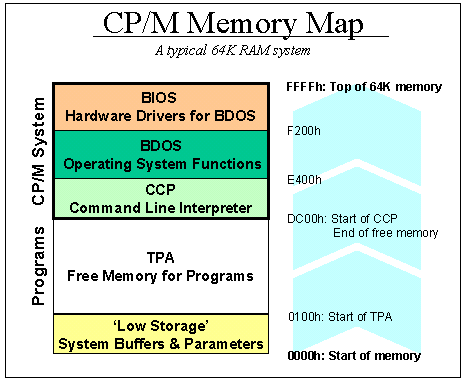
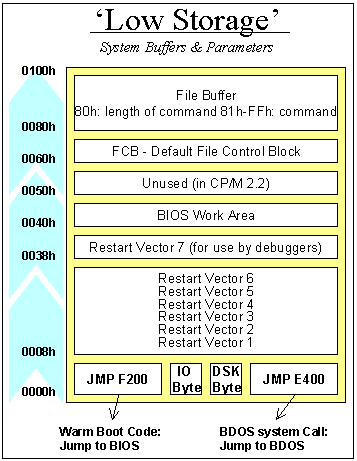
Memory map
File Control Block
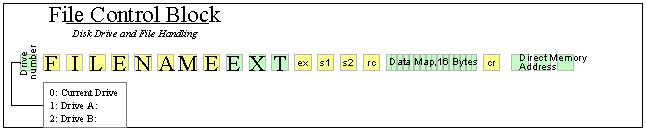
FCB start: 5Ch (not 60h as in the picture).
FCB       EQU  5Ch   ; File Control Block
FCBFNAME EQU FCB+1 ; FCB File Name | Address | Field | Definition |
|---|---|---|
FCB+00h |
dr | drive code (0-16) 0 = use default drive for file 1 = auto disk select drive A, 2 = auto disk select drive B, ... 16 = auto disk select drive P. |
FCB+01h |
f1...f8 | contain the filename in ASCII upper-case, with high bit = 0 |
FCB+09h |
t1,t2,t3 | contain the filetype in ASCII upper-case, with high bit = 0. t1', t2', and t3' denote the bit of these positions, t1' = 1 = Read-Only file, t2' = 1 = SYS file, no DIR list |
FCB+0Ch |
ex | contains the current extent number, normally set to 00 by the user, but in range 0-31 during file I/O |
FCB+0Dh |
s1 | reserved for internal system use |
FCB+0Eh |
s2 | reserved for internal system use, set to zero on call to OPEN, MAKE, SEARCH |
FCB+0Fh |
rc | record count for extent ex; takes on values from 0-127; Set this to 0 when opening a file |
FCB+10h |
d0...dn | filled in by CP/M; reserved for system use |
FCB+20h |
cr | current record to read or write in a sequential file operation; normally set to zero by user after opening file |
FCB+21h |
r0,r1,r2 | optional random record number in the range 0- 65535, with overflow to r2, r0, r1 constitute a 16-bit value with low byte r0, and high byte r1 |
File Buffer start: 80h (128 bytes long).
Notes
6Ch. It will be overwritten by file operations.
If no arguments are given the FCB file name is all blank/space characters ( )
Command line arguments are also available from 80h (File Buffer).
Useful constants:
FCB       EQU  5Ch     ; File Control Block
FCBFNAME  EQU  FCB+01h ; FCB File Name
FCBEX     EQU  FCB+0Ch ; FCB Excent Number
FCBRC     EQU  FCB+0Fh ; FCB Record Count
FCBCR     EQU  FCB+20h ; FCB Current Record
FB EQU 80h ; File BufferSelectedCP/M procedures
| Function Number |
|---|
Name Input Output Dec Hex
01hA = ASCII char
03hOutput
E = char
09h$A = ASCII char
0AhReading file
Given file name in the arguments one can first check if argument was given by checking for space character in FCBFNAME (FBC + 01h).
If file name is used.filled Linewe outputcan open the file:
     XOR  A
     LD   (FCBEX),A   ; select 0'th extent
     LD   (FCBRC),A   ; clear
     LD   (FCBCR),A   ; clear
     LD   C,FOPE      ; open file
     LD   DE,FCB      ; use default FCB
     CALL BDOS
Set EX, RC and CR to 0 and call File Open (0Fh). A will contain FFh if file was not found.
Next file can be read:
     XOR  A
     LD   (FCBCR),A ; start from beginning
     LD   C,FRED    ; read file
     LD   DE,FCB    ; use default FCB
     CALL BDOS
Set CR to 0 to start reading from beginning of file and call Read Sequential (14h). A is writtenset startingto from0 2'ndif read was successful.
128 bytes was read to FB (80h). CR (and EX) will be automatically incremented, so calling Read Sequential again will read next 128 byte of the buffer. 0'th byte should be the length of the buffer, 1'st byte is ignored.